


How to Free One Negotiator Day per Week Without Hiring Anyone
Dear Estate Agents,
Let’s talk about the most valuable asset in your branch.
It’s not your portal spend, or your branding, or even your stock. It’s your best negotiator’s time because if your top negotiator had one extra day a week to focus on serious buyers and hot instructions.
What would that be worth to your branch?
1 or 2 extra completions a month?
More pipeline?
Better fees?
Now flip the question:
How much of that time is currently being burned on tyre-kickers, no-shows, and dead-end portal leads?

Walk Into Every Valuation With Buyers Already Lined Up
If you’ve ever fought for a valuation against three other estate agents, then you already know:
The estate agent with the strongest proof of demand wins every single time.
Not the one with the fanciest brochure, or the biggest branch, or the cheapest fee.
The one who walks in and confidently says:
“We already have buyers looking for a home exactly like yours.”
That estate agent wins instructions at higher fees, with less negotiation, and greater trust from the vendor.
But here’s the problem:
Most agents don’t have that advantage, not because buyers don’t exist but because traditional property portals weren’t designed to show you who’s looking, only who’s browsing. But browsing doesn’t win valuations.

From 100 Enquiries to 10 Serious Buyers: Why Volume Is Killing Your Pipeline
Let’s talk about a problem every estate agent knows too well, but no one in PropTech wants to admit.
Your inbox looks full, your phones are ringing and the leads keep pouring in, but when you actually dig into it you realise something:
Out of 100 enquiries, maybe 10 are serious.
Maybe 2 book a viewing.
And only 1 if you’re lucky actually makes an offer.
That’s not lead generation, that’s lead wastage.

Why Most Estate Agents Will Miss the AI Shift and How a Few Will Win Big
Let’s start with a truth most people in the industry won’t say out loud: proptech isn’t slow, estate agents are.
Not because they aren’t smart, and not because they don’t care, but because the industry has been conditioned to believe that “what worked yesterday will work tomorrow.” And that’s exactly why only a handful of forward thinking estate agents: the ones who embrace AI early will win big over the next 12 months, whilst everyone else stands still as the market moves on without them.

Property Seekr May Be Powered by AI But It’s Designed for You
Let’s be honest, nobody lies awake at night dreaming about “filters” and “search radius”.
You don’t fantasise about toggling between “furnished” and “part-furnished”.
You dream in feelings:
The first coffee in your new kitchen.
Your kid’s school run that doesn’t involve a 90-minute commute.
Movie night in a living room that actually fits a sofa and your friends.
A balcony where you can breathe after a long day.
You’re not thinking in “2 bed · £1,800 · Zone 3”.
You’re thinking:
“Can I picture us coming home here?”
That’s a very different search, but today’s property portals still expect you to reduce all of that into a few keywords and dropdowns.
It’s no wonder the process feels broken.

The Buyer Who Had 32 Tabs Open and Still Couldn’t Find a Home
Meet Sophie.
She’s 34, a marketing manager in London, and after years of renting, she’s finally ready to buy her first home.
She’s done everything “right”. Saved for years, got her mortgage in principle, and even made a Pinterest board titled My First Home.
On a Sunday morning, she opens her laptop with a cup tea in hand (that’s how the English do it) and begins what should be the most exciting part of her journey: finding the place she’ll call home.
She loads up a property portal and a few local estate agents’ websites.
By 11am, she has 32 tabs open.

What Happens When You Build a Property Platform Around People Not Listings
Building for People: How Property Seekr is Redefining the Home Searching Experience from the Ground Up
Property portals were built to display listings, not understand people. Endless filters, generic results, no empathy for real-life needs. They don’t care that you need space for your morning yoga routine. They don’t care that the so-called “home office” shouldn’t be a converted cupboard, but we believe buying a home is too important to leave to generic drop-down menus and keyword matching.

Here’s Why We’re Not Building Another Property Portal
Let’s get this out of the way first: we’re not building another property portal. No more copy-paste listings, no more banner ads, and no more scrolling through 200 homes that have nothing to do with what you actually want because the truth is, traditional property portals aren’t technology companies anymore. They are advertising machines wearing PropTech clothes. They make money when buyers click, not when they find, and that’s exactly what we’re here to change.

The Future of Real Estate Belongs to Platforms That Listen, Not Just List
If we’re being honest with ourselves, we all know and feel that property portals all feel the same. You open one up and you’re met with rows of rectangles asking for bedrooms, bathrooms, price and postcode. Maybe you apply a few more filters, maybe you don’t. Either way, you’re left with the same question:
“Why does this still feel like guesswork?”
Because it is.
Traditional property portals don’t really help you find a home, they just list them. They’re built for volume, not understanding. For clicks, not connections. For data, not desire, and that’s the problem.
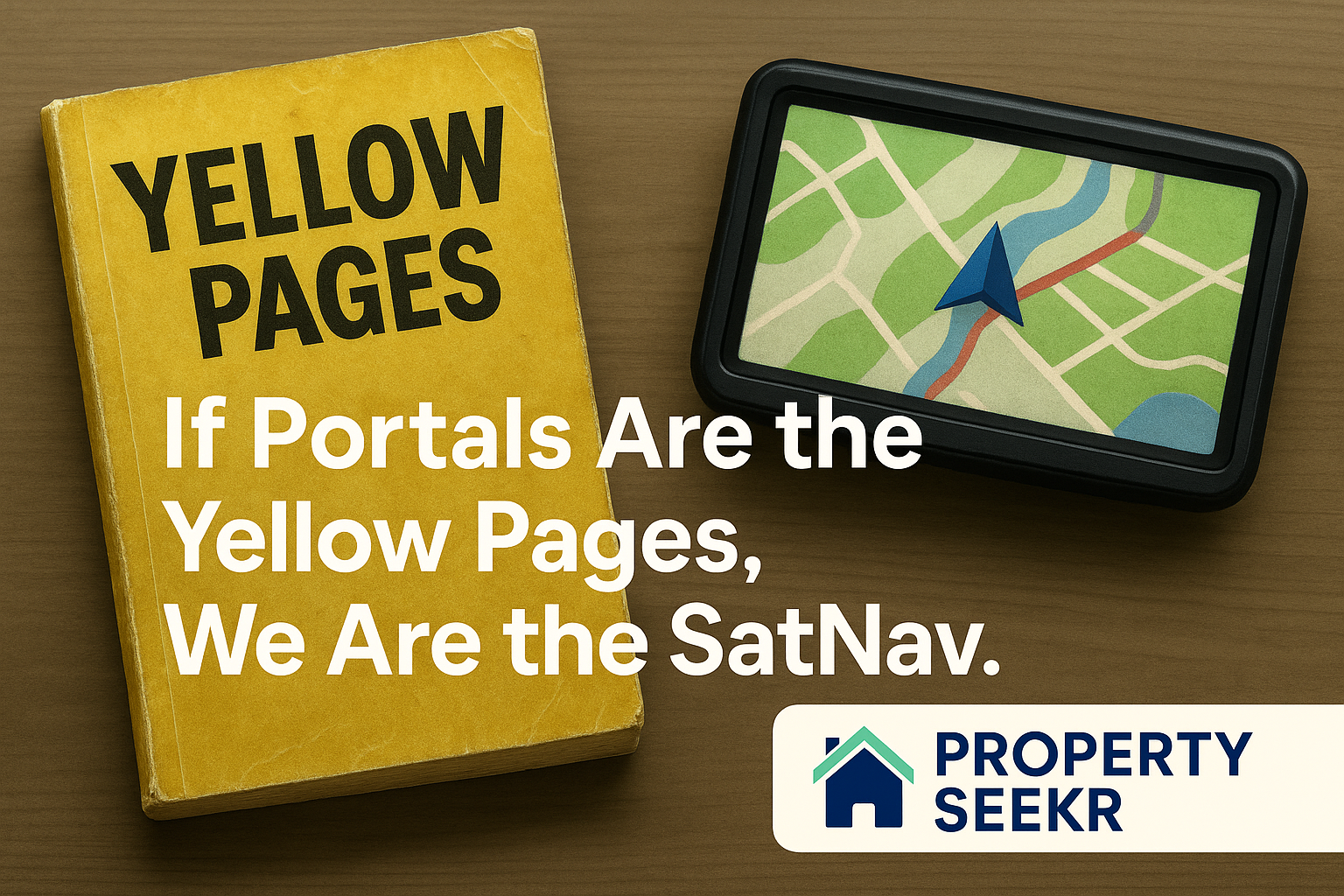
If Portals Are the Yellow Pages, We Are the SatNav
Remember the Yellow Pages?
Every business, every plumber, every electrician: thousands of numbers squashed into a fat yellow book. It gave you everything, but not necessarily what you actually needed. Then Google came along, and suddenly, you didn’t have to flip through 500 irrelevant ads to find the one café that was open late. You typed what you wanted, and you got precision.
That shift, from overload to relevance changed how we navigate the world, and now, it’s happening in real estate.

Why Property Seekr is Building for Usefulness, Not Hype
AI is everywhere!
It’s in the headlines, in pitch decks, and in every other startup claiming to “revolutionise” something. But the truth is most AI doesn’t stick because it’s not useful.
The AI that actually changes our lives isn’t flashy. It doesn’t need a press release. It just works.
A good example of this is Google Maps.

What Traditional Property Portals Don’t Want You to Know About Your Data
Let’s start with a simple truth: if a product is free, you’re not the customer, you’re the commodity, and in property search, that’s never been more obvious.
We all use traditional property portals, and we all rely on them, but have you ever wondered why they feel so cluttered, so noisy, so… desperate for clicks? It’s because property portals don’t make money when you find a home. They make money when you scroll through one. Their business model is built on attention, not outcomes. Every second you spend browsing, filtering, clicking, hesitating, they are learning about you, your budget, your habits, and your neighbourhood preferences. Even how long you linger on a listing tells them what kind of buyer you are, and all that data is not helping you, it’s helping them sell more ads.

The PropTech Opportunity No One Is Talking About (But Should Be)
PropTech is loud! Every few months, a new platform appears promising to “revolutionise the real estate sector”, but most don’t. Instead, they build shinier versions of the same thing: another portal, another filter, or another layer of noise. Meanwhile, the biggest players: traditional property portals are still playing the same old game. Their innovation involves marginal UX tweaks, higher listing fees, and “AI” that’s really just better sorting.
The truth is the housing market doesn’t need another listing site, it needs a listening system, and that’s exactly where the opportunity lies.

Why Every Estate Agent Will Be Using AI in 12 Months Or Be Left Behind
Let’s be real.
The property industry is changing and fast. Buyers expect smarter, faster, more personalised experiences, and estate agents who don’t evolve will be invisible.
We’ve seen this story before in travel, retail, finance, and marketing. Every industry that delayed AI adoption didn’t just lose ground… they lost relevance.
Now, that same wave is hitting real estate.

The Home That Was Never Found Because the Right Buyer Never Saw It
It was a beautiful two-bed flat in South London with a south-facing garden, exposed brick and a skylight kitchen. The kind of place you walk into and immediately feel at home. It had everything going for it: great location, perfect price, stunning design, and yet… it sat untouched for 45 days. No offers, and very few viewings. It was as if the flat was invisible, not because it wasn’t a great home but because the right buyer never saw it.

What If Property Portals Were Built Like Dating Apps?
Let’s be honest! Dating apps promised us healthy loving relationships and soulmates, but what we actual got were swipes, situationships, and second guesses. But despite all the chaos, the idea of matchmaking still resonates with us. We don’t want more profiles, we want the right one. It’s the precise personalisation that drives us back to matchmaking.
Now, imagine if property portals worked the same way. What if, instead of showing you 10,000 random homes…, you were instantly matched with the one that actually fits your life, wouldn’t that make your life a whole lot better? Just image the amount of value, piece of mind and delight that would bring into your life.
This is our purpose at Property Seekr, we’re building the “Tinder for Homes”, except, unlike Tinder, our AI knows and cares about what you actually want. We intend to deliver value in the form of your dream home so you can go and live the kind of life you envisioned for yourself and your loved ones.

Discovery Over Listings: What We Learnt from Google Maps
Think back to the days before Google Maps. You’d pull out a crumpled A–Z map, plot your route, and hope for the best. This worked… technically, but it was clunky, rigid, and full of wrong turns. Then Google Maps came along and changed the game. Suddenly you weren’t just getting from A to B — you were discovering. You searched for “coffee” and found your new favourite café, you looked for “restaurants nearby” and uncovered gems you’d never have known existed. Google Maps didn’t just replace the A–Z map, it unlocked intent.
That’s exactly what Property Seekr is bringing to real estate.

The Hidden Cost of Listing on Legacy Property Portals
Dear Estate Agents,
Let’s talk openly for a moment, you’re probably paying hundreds, perhaps even thousands of British pounds each month to list your properties on big-name portals. But have you ever wondered what you’re truly getting for that investment?
They promise exposure. They promise traffic. They promise leads.
But be honest, when’s the last time you looked at your subscription invoice and thought:
“Yes. Every penny was worth it.”

You Only Need One Match
You don’t need 200 listings, you just need one match. The one that makes you stop scrolling mid-swipe. The one that pulls you out of autopilot and makes you imagine your mornings. The one where you can already see your dog curled up by the window, with the smell of fresh coffee filling the kitchen, and sunlight spilling across the table because the truth of the matter is you don’t really want endless options when you’re searching for a home that suits your lifestyle, you want certainty.
We’re Building the Google Maps of Home Buying
Property Search Feels Like Road Rage — That’s Why We’re Building the Google Maps of Home Buying
Do you remember travel before Google Maps?
You’d unfold a paper map, argue over whether to take the A-road or the B-road, and inevitably make a wrong turn that added 40 minutes to your trip. It was stressful, time-consuming and confusing. Fast forward to today: a few clicks on your smartphone, and Google Maps guides you to exactly where you need to be. It doesn’t just show you roads, it shows you the right road for you.
Now, let’s talk about property search in 2025.
It still feels like flipping through an outdated road atlas, wrong turns, confusing options, a thousand “routes” that technically get you there…but none that feel like they have been built for you, and here’s the kicker: a wrong turn doesn’t just cost you time. It could cost you a lot of money, somewhere in the region of £250,000 — £500,000.